
Since the collapse of the Soviet Union, one thing is undeniably true: the borders of NATO have moved closer to Russia.
It has been a great era of NATO expansion, which would obviously be a trigger for a country sitting on the other side of the fence.
When in doubt, ask yourself this: if Russia said it was looking to establish a permanent military presence in Canada, Mexico, or Greenland, would the NATO countries nearby sit idly and say, “Well, sovereign countries can choose their own alliances”?
Think about that for a second. I wouldn’t bet on the ‘sit idly’ part.
People Prefer to Follow Rules They Like
The so called ‘rules based’ world order is gone and it is not coming back. In fact, it is worth discussing that it might never have been a ‘rules based’ world order. People tend to defend their side against the other side. As is inherent to human beings, the world picks sides. When something is beneficial to Side A, they support it. When it is beneficial to Side B, they oppose it. Remember the bombing of Belgrade and what happened in Yugoslavia? Libya? The WMD debacle in Iraq?
I won’t delve too deeply into this debate, although it is certainly an interesting one. What I am trying to say is that the world is not black or white. It has many shades of grey.
The reason we should discuss these things with our eyes wide open and be prepared to play devil’s advocate is simple: without a thorough understanding of the interests and positions of each side, it is impossible to reach any sort of positive—or at the very least neutral—resolution to a conflict, be it hot or cold.
I digress.
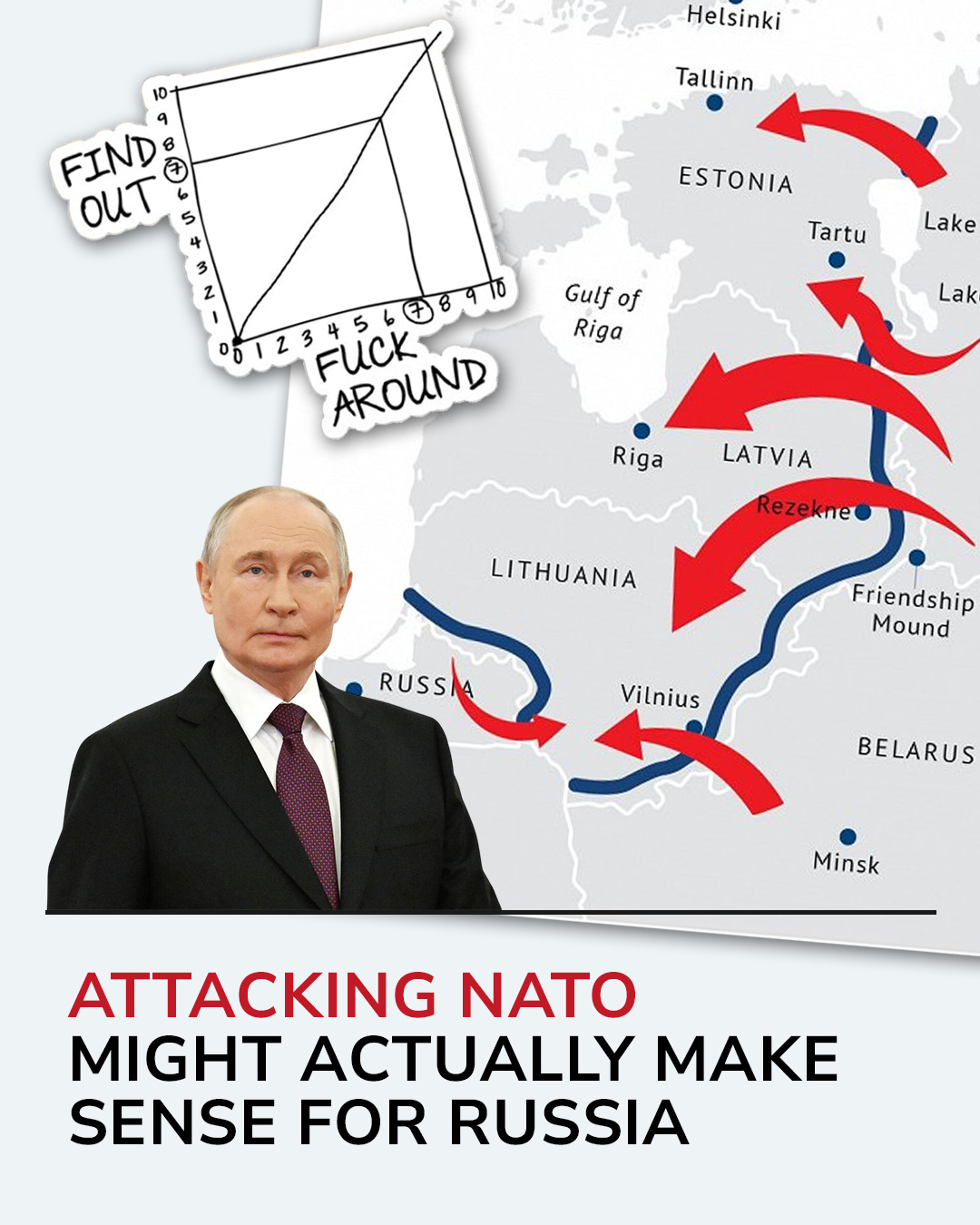
Are We About to Find Out?
This brings me to the topic at hand: why, militarily speaking, it can make sense for Russia to attack—and why that window of opportunity is quite narrow.
Let’s assume that we fucked around at about the 7 level. Are we about to find out? What would that look like? Short of level 10, which is nuclear warfare, of course. Or at least I hope.
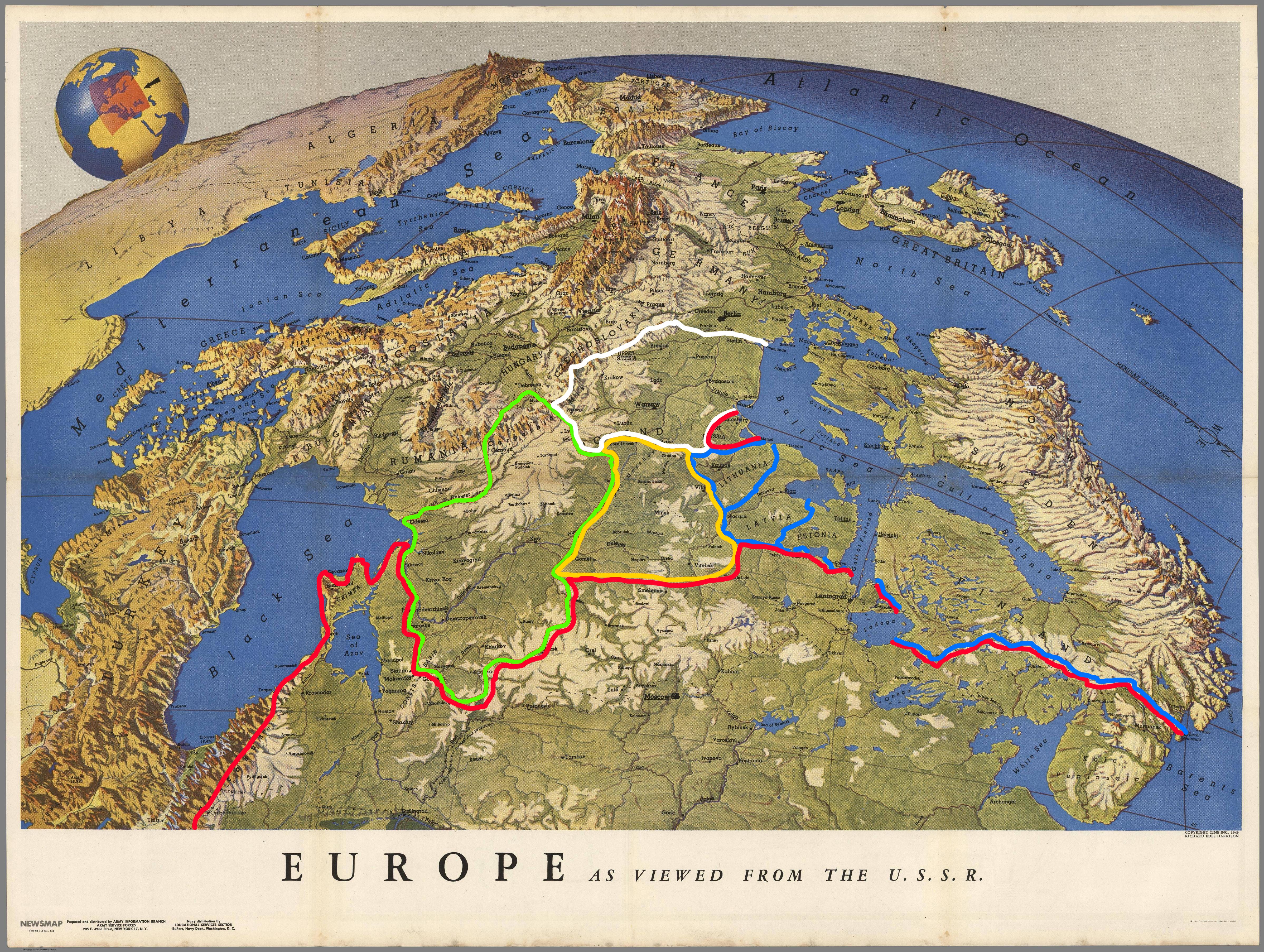
Before we jump in, I want to show you an old map called “Europe as viewed from the U.S.S.R.” it is as relevant now as it was in the past. On this map, I highlighted the following countries, following their current borders as closely as possible, but expect a few errors, as I was doing this manually:
Green: Ukraine, but only the territories currently under Ukrainian control.
Yellow: Belarus
Blue: Lithuania, Latvia, Estonia, and Finland
White: Poland
Red: Russia
As you can see below, the Baltics are really between a rock and a hard place. Especially, if Belarus is involved.
The Principles of War
Before we discuss why I think it is highly likely that an attack might actually happen, we need to understand what typically drives strategic thinking in any war—hot or cold.
The ten Principles of War listed below have been adopted by the Canadian Chiefs of Staff Committee for the use and guidance of the Canadian Armed Forces. Feel free to do some research on this online; there are plenty of resources available.
Defining a principle as a guide to conduct, the following are the principles that must always influence commanders in war:
Selection and Maintenance of the Aim - In the conduct of war as a whole and in every operation of war it is essential to select and clearly define the aim. The ultimate aim is to break the enemy’s will to fight. All efforts must be directed to its attainment until a changed situation calls for a re-appreciation and consequently a new aim. This must be regarded as the “Master” Principle.
Maintenance of Morale - Success in war depends more on moral than on physical qualities. Numbers, armament and resources cannot compensate for lack of courage, energy, determination, skill and the bold offensive spirit which springs from a national determination to conquer. The development and subsequent maintenance of the qualities of morale are, therefore, essential to success in war.
Offensive Action - Offensive action is the necessary forerunner of victory; it may be delayed, but until the initiative is seized and the offensive taken victory is impossible.
Security - A sufficient degree of security is essential in order to obtain freedom of action to launch a bold offensive in pursuit of the selected aim. This entails adequate defence of vulnerable bases and other interests which are vital to the nation or the armed forces. Security does not imply undue caution and avoidance of all risks, for bold action is essential to success in war; on the contrary, with security provided for, unexpected developments are unlikely to interfere seriously with the pursuit of a vigorous offensive.
Surprise - The most effective and powerful influence in war, and its moral effect is very great. Every endeavour must be made to surprise the enemy and to guard against being surprised. By the use of surprise, results out of all proportion to the effort expended can be obtained, and in some operations, when other factors are unfavourable, surprise may be essential to success. Surprise can be achieved strategically, tactically or by exploiting new material. The elements of surprise are secrecy, concealment, deception, originality, audacity and rapidity.
Concentration of Force - To achieve success in war, it is essential to concentrate superior force, moral or material, to that of the enemy at the decisive time and place. Concentration does not necessarily imply a massing of forces, but rather having them so disposed as to be able to unite to deliver the decisive blow when and where required, or to counter the enemy’s threats.
Economy of Effort - This implies a balanced employment of forces, and a judicious expenditure of all resources with the object of achieving an effective concentration at the decisive time and place.
Flexibility - Modern war demands a high degree of flexibility to enable pre- arranged plans to be altered to meet changing situations and unexpected developments.
Co-operation - Based on team spirit and entails the co-ordination of all units so as to achieve the maximum combined effort from the whole.
Administration - The administrative arrangements must be designed to give the Commanders the maximum freedom of action in carrying out any plan.
With that out of the way, I hope you are still reading.
Fortunately, we won’t be able to cover all of these principles. Here are the ones I think are the most important for our analysis:
Offensive Action
Security
Surprise
Concentration of Force
Flexibility
The others are either self-explanatory or impossible for us to realistically evaluate in such a short amount of time.
What Does Russia Want?
While I won’t go in-depth into this Principle of War, it is the “Master” Principle, so we need to touch on it: Selection and Maintenance of Aim.
We can only guess what Russia’s aim is, but we can safely assume Russia has one. I’ll use Occam’s Razor here and say that, in this case, it might be counterproductive to come up with elaborate explanations. Therefore, let’s take Putin’s words for what they are:
They don’t want an opposing military alliance (i.e. NATO) on their border, especially when it involves countries with which they have historic ties. Some sort of buffer would certainly help defuse tensions between the two sides.
Keep that aim in mind throughout the rest of this article. I say again: they don’t want an opposing military alliance (i.e. NATO) on their border.
I was going to go over what has happened in Ukraine since 2013, but that will have to be another article. In short, just like 12 years ago, Russia probably has the same aim and wants to restore its sphere of influence. Nothing crazy here. Most people will probably acknowledge that Russia wants to maintain its influence and prevent countries on its border from joining NATO.
Now, if you’re on the Western side of the fence, you probably picked the side that wants to grow the influence of your side, so you view NATO expansion as democracy at work. After all, NATO is not invading anyone here, am I right? However, if this were the Warsaw Pact expanding westward, the roles would flip, and many of the same people who support NATO expansion would oppose Warsaw Pact expansion.
See where I’m going with this? Everyone is picking sides instead of analyzing the situation to find a solution that will work.
Russia’s aim is the same as it was before.
Let’s take it for what it is.
Current State
Now, is Russia achieving its aim right now? Let’s take a look:
NATO gained two new members on Russia’s border, turning the Baltic Sea into the “Lake of NATO,” or whatever the internet calls it these days.
Offensives are excruciatingly slow.
Western aid to Ukraine—aside from air defence missiles—has not really slowed down.
Ukraine is coming up with new technologies, methods, and innovative solutions to complex problems on the battlefield. Russia is too; it goes both ways. But from Russia’s perspective, the longer this goes on, the less likely it is that Russia can simply break Ukraine.
So if the aim stayed the same, but banging your head against the wall in Eastern Ukraine is not working, what do you do?
The right answer is: look for options.
Russia’s Options
Attack Ukraine from another side. The problem is that Ukraine probably expects that possibility and might be prepared.
