
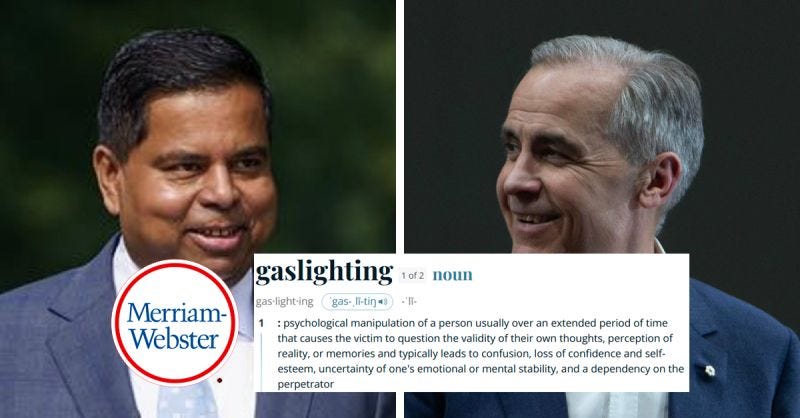
The Right Honourable Marc Carney, Prime Minister of Canada, recently said:
“What the government is doing with the gun registry is putting in place a much more efficient way for Canadians to voluntarily return prohibited firearms for fair compensation.”
He is referring to firearms the Government of Canada prohibited through Orders in Council over the past several years. Canadians affected are now presented with three options: destroy their property, hand it over, or face jail time.
Voluntary
Merriam-Webster — “done or given because one wants to and not because one is forced.”
Jail
According to the Government of Canada’s Charterpedia on Section 7 of the Charter, liberty includes protection against physical restraint. Imprisonment or the threat of imprisonment engages the liberty interest. (Government of Canada. Section 7 – Life, liberty, and security of the person)
Gaslighting
Merriam-Webster — “psychological manipulation that causes a person to question the validity of their own thoughts, perception of reality, or memories.”
In the 1930s, Soviet authorities under Joseph Stalin described collectivization in Ukraine as voluntary. In practice, people — including members of my family — were given three options: surrender their farms and livestock, be exiled to Siberia, or face execution. That deception produced the Holodomor, the man-made famine of 1932–33 that killed up to 10 million Ukrainians.
Afterwards, Moscow brought in migrants to replace the Ukrainians who had perished. These newcomers had no ties to the land or loyalty to the local culture. That demographic engineering sowed turmoil and helped set the stage for the war that began in 2014 with the loss of Crimea and parts of the Donbas, and ultimately the full-scale invasion in 2022.
During COVID-19, vaccination was described as a matter of personal choice. For many Canadians, however, refusal resulted in loss of employment or restrictions on access to parts of public life.
In Ukraine, the war made survival the priority. Mandates and restrictions became irrelevant, and many people simply worked around them.
