
For all the talk about Ukraine defending Europe, there is one question I do not hear asked often enough: what will be left of Ukraine when this is over?
A country needs more than a flag, internationally recognized borders, and sympathetic speeches from foreign leaders. It needs people who can afford to live there, raise children, build businesses, and pass something on to the next generation.
Weakening Russia may serve the interests of Ukraine’s partners. But weakening Russia and securing a viable future for Ukraine are not necessarily the same thing. At some point, we need to stop treating them as though they are.
Demographics
Ukraine’s demographic history did not begin in 1991, and Ukrainians did not exist only within Ukraine’s present borders.
The numbers need some care: counting ethnic Ukrainians is not the same as counting everyone living in Ukraine. Additionally, the sources and the differences in methodologies may impact the accuracy of these estimates, but you’ll at least get the big picture - the Ukrainian population was increasing throughout history quite steadily.
With that in mind, consider this:
1550–1650: Historical estimates put the Ukrainian population at approximately 4.9 million in 1550, rising to 5.3 million in 1650. These are reconstructions, not modern census counts.
1795: Approximately 8.2 million Ukrainians within the Russian Empire, excluding those living beyond its borders.
1834: Approximately 11 million Ukrainians.
1858: Approximately 13 million Ukrainians.
1897: Approximately 22.4 million Ukrainians.
1926: Approximately 31.2 million Ukrainians across the USSR, including those living outside the Ukrainian Soviet Socialist Republic.
1932–1934: Reconstructed estimates put the population of Soviet Ukraine at 31.4 million at the beginning of 1932, falling to 27.8 million at the beginning of 1934. These figures count all residents within the republic’s borders at that time.
1959: Approximately 41.9 million residents in Ukraine, with another 5.1 million ethnic Ukrainians living elsewhere in the USSR.
1970: Approximately 47.1 million residents in Ukraine, with another 5.5 million ethnic Ukrainians elsewhere in the USSR.
1979: Approximately 49.8 million residents in Ukraine, with another 5.9 million ethnic Ukrainians elsewhere in the USSR.
1989: Approximately 51.7 million residents in Ukraine, with another 6.8 million ethnic Ukrainians elsewhere in the USSR, before even considering the diaspora beyond Soviet borders.
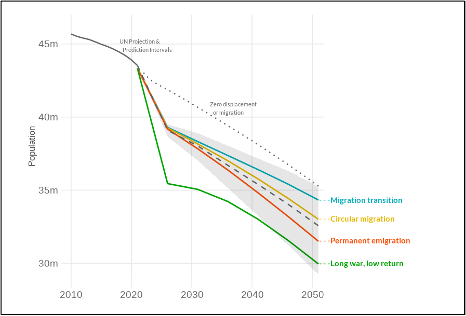
In 1991, Ukraine inherited a population of nearly 52 million people. Since that time it came down to between 42 and 44 million people prior to 2022, but went steadily downhill from there with present estimates ranging anywhere between 22 and 29 million people living on the territories controlled the Ukrainian government.
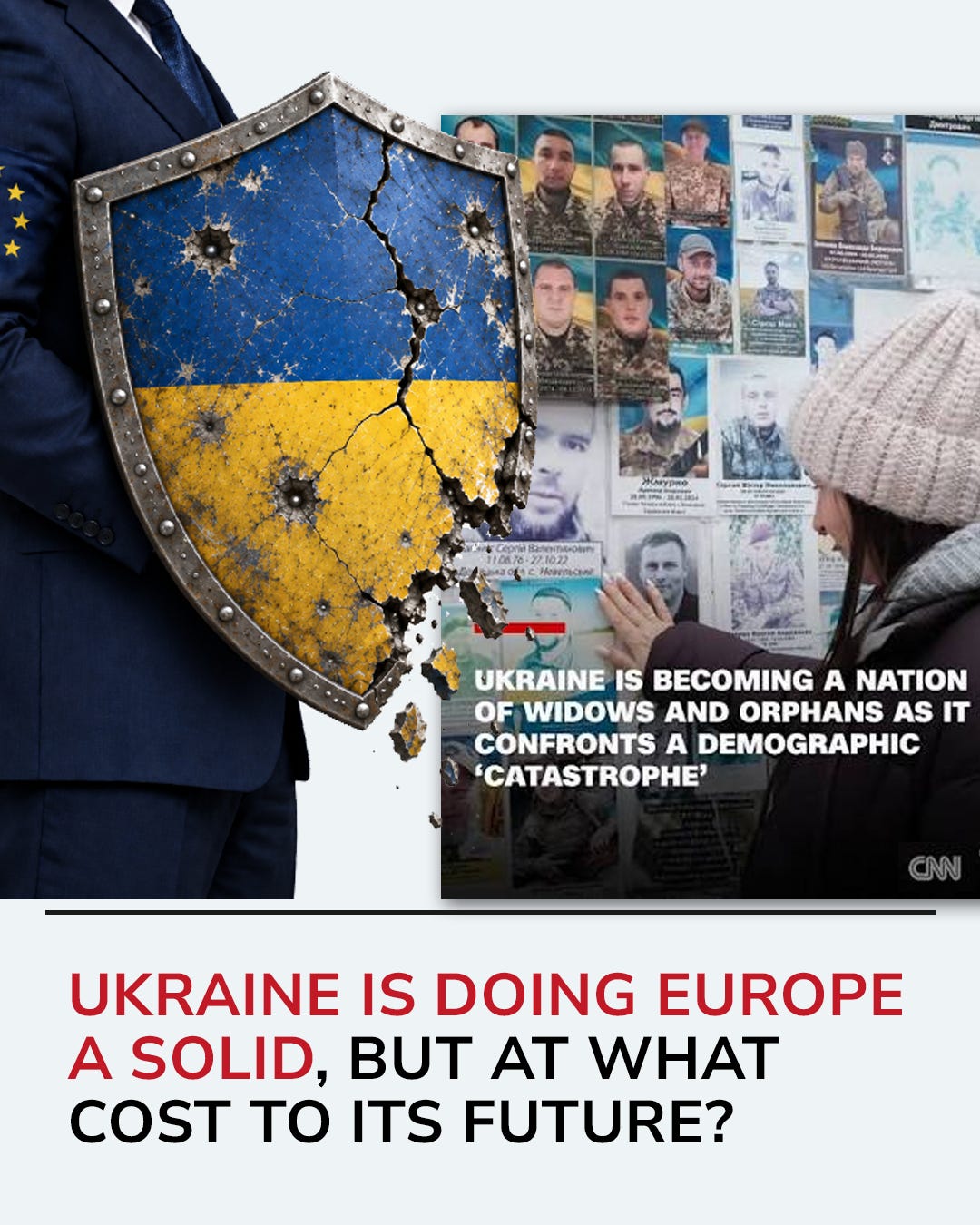
Ukraine is becoming a nation of widows and orphans as it confronts a demographic ‘catastrophe’
CNN, February 22, 2026
(https://www.cnn.com/2026/02/22/europe/ukraine-widows-demographic-crisis-intl)
The figure below illustrates this demographic trend, but the problem is that the last official census was done in 2001, so everything after that are educated guesses. As stated above, modern estimates are actually much lower than what is shown here.
Gloomy picture, isn’t it?
None of this means there were no natural or man-made population declines. But neither was this a history of uninterrupted demographic decline. It was not all dark and gloomy, however convenient that interpretation might be for today’s arguments.
War has added displacement on an enormous scale. By February 2026, UNHCR reported approximately 5.9 million refugees from Ukraine abroad, alongside approximately 3.7 million internally displaced people.
Those who left have not stopped being Ukrainian. But retaining an identity abroad and sustaining a country at home are different things.
Children settle into schools. Parents find work. Families learn another language and establish another life. At some point, returning to Ukraine may mean uprooting themselves all over again.
And what about their children? Or the children those children will eventually have?
The longer this continues, the more Ukraine risks losing not only its present population, but future generations who might otherwise have lived there. A nation can maintain a large diaspora and still struggle to maintain the country from which that diaspora came.
Economy
The financial picture is hardly more reassuring.
The Kyiv Independent looked into Ukraine’s growing debt and reported that public and publicly guaranteed debt had exceeded US$213 billion by the end of 2025. Much of the increase came from borrowing from official foreign creditors.1
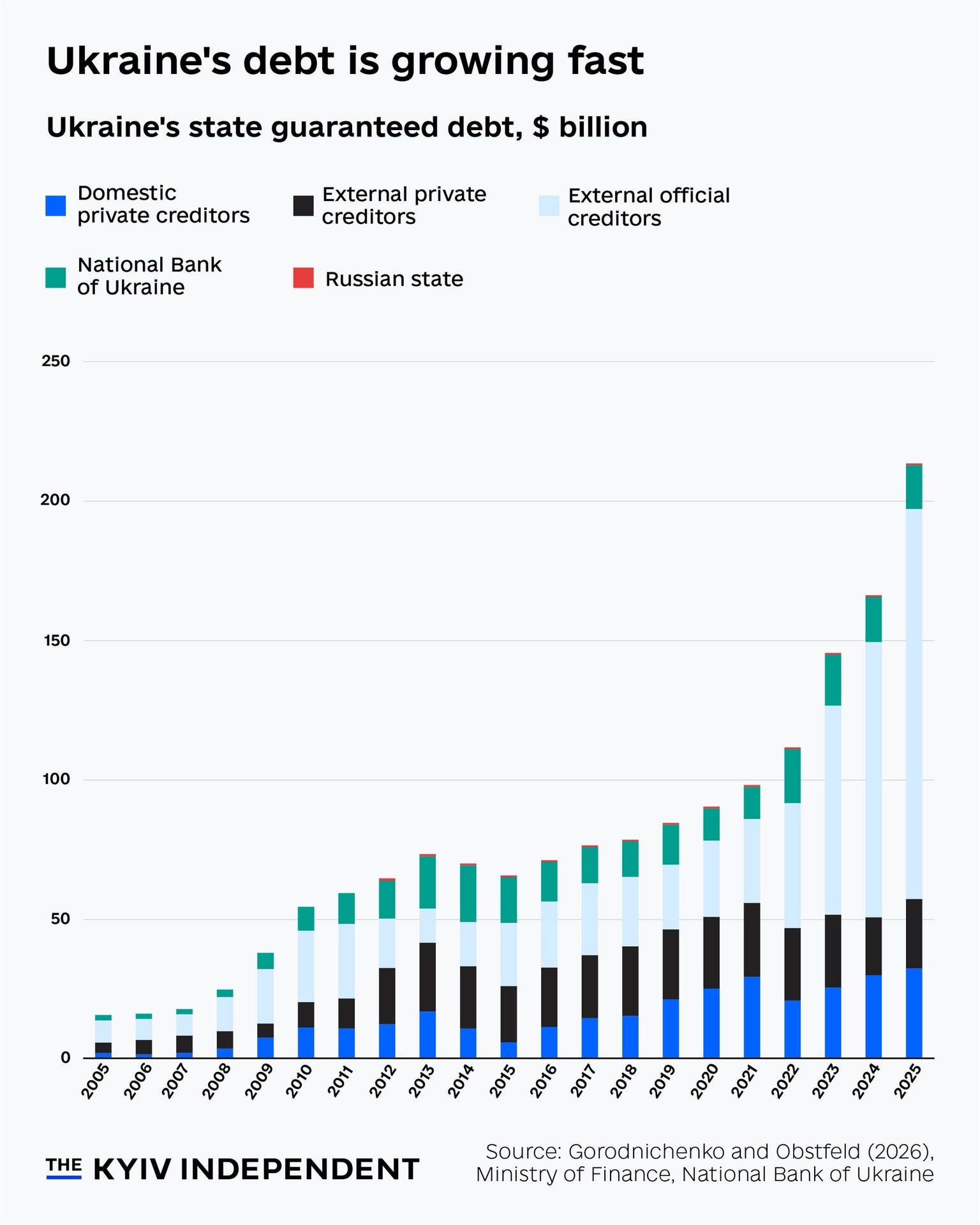
Not every dollar carries the same repayment burden. Some loans have exceptionally favourable terms. The G7’s ERA loans are intended to be serviced from earnings on immobilized Russian assets, while repayment of the EU’s Ukraine Support Loan is tied to Russia paying reparations, the possibility of which is questionable at best.
Ukraine spent approximately US$6.8 billion on interest in 2024 alone, equivalent to roughly 4 percent of GDP. That is interest, not repayments of principal. The problem is that Ukraine must carry its interest bill while also financing a war and rebuilding what is being destroyed.
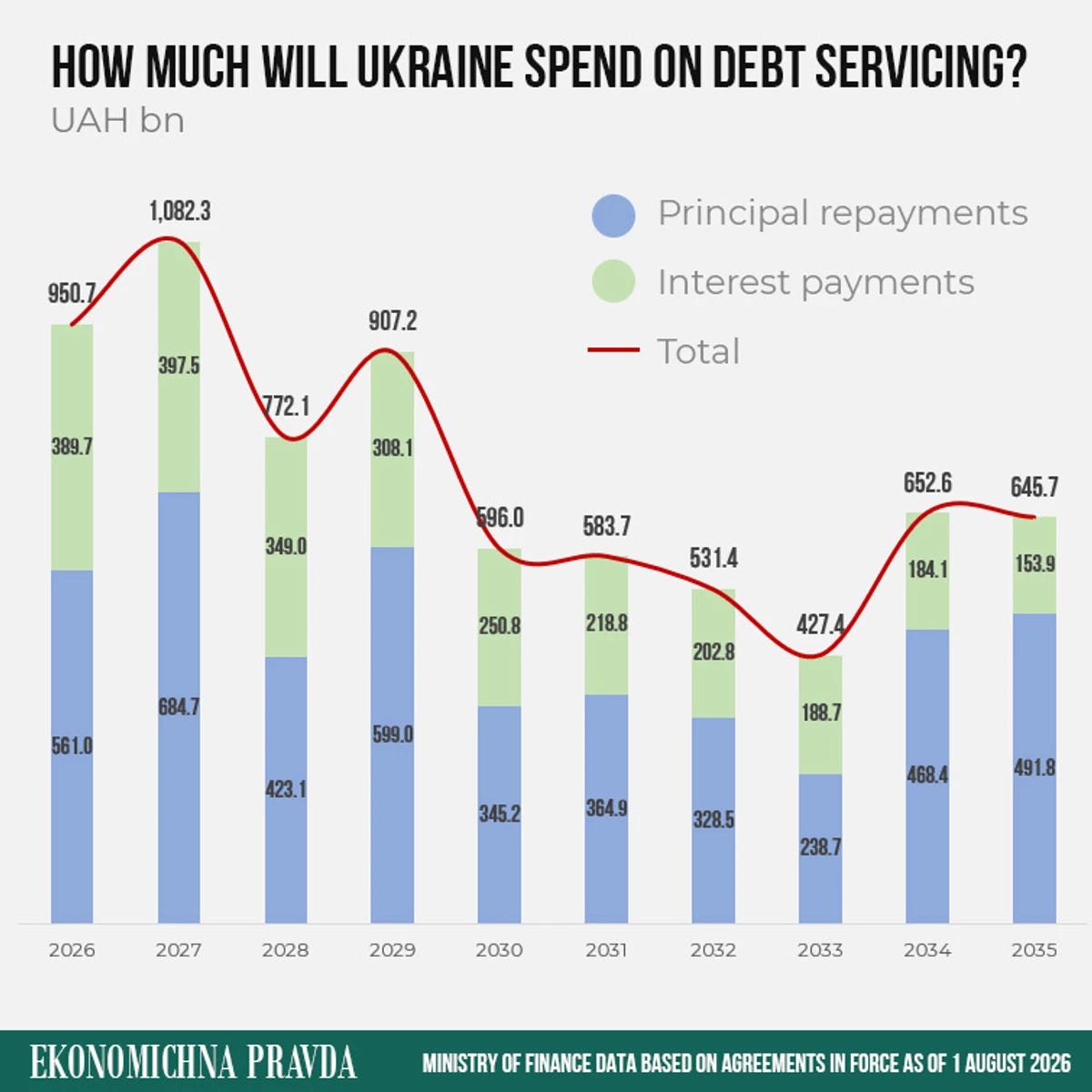
Source: https://www.pravda.com.ua/eng/articles/2026/09/08/8052448/
A joint assessment by the Ukrainian government, World Bank, European Commission, and United Nations put direct damage through the end of 2025 at more than US$195 billion, with almost US$588 billion needed for recovery and reconstruction over the following decade. Those reconstruction needs are not existing government debt, but someone will still have to pay for them.
Replacing a destroyed power station or repairing a bridge does not necessarily make the country richer than it was before. It merely restores something the country already had.
Meanwhile, people who could help rebuild Ukraine are contributing to other economies.
A Deloitte study published with UNHCR estimated that Ukrainian refugees’ presence had a positive net effect equivalent to 2.7 percent of Poland’s GDP in 2024. The Polish Economic Institute also found that Ukrainians established approximately 77,700 sole proprietorships and 11,300 companies with Ukrainian capital in Poland during 2022–2024.
These are not all companies that physically relocated from Ukraine. Many are new businesses. But that is precisely the point: Ukrainians are building new economic lives elsewhere.
There is nothing wrong with families supporting themselves or entrepreneurs taking opportunities. The question is what Ukraine will have to offer to bring that activity home.
Then there is the sale of state assets.
In August 2026, the Kyiv Independent reported that Ukraine was seeking foreign investors for privatization auctions, while domestic buyers are far and few between.2
One example was the Odesa Portside Plant. Its planned auction starting price was approximately US$100 million, a mere one-fifth of its 2009 auction price. The State Property Fund’s leadership acknowledged that assets were being offered at discounted prices, while arguing that strategic investors would bring long-term commitments.
Perhaps they will. But selling under pressure is not the same as selling from a position of strength.
An investor who can afford to wait for peace may eventually acquire something very valuable. A government that needs money now has considerably less room to wait. Ukrainians are entitled to ask whether they will receive a fair share of the eventual recovery.
Agricultural land raises a similar concern.
The legal framework opening Ukraine’s land market reserved foreign access for a national referendum. Meanwhile, discussions have continued: a June 2026 event summarized by the Kyiv School of Economics (KSE) considered opening the market to EU citizens and companies, alongside concerns about ownership concentration and access for Ukrainian farmers.
However, a referendum cannot equalize purchasing power. Should access expand, a Ukrainian farmer trying to recover from years of war could find themselves competing with a foreign investor able to borrow more cheaply and wait much longer for a return. Promises of affordable loans for Ukrainians are only useful if Ukrainians can actually obtain them.
The same KSE discussion highlighted practical difficulties with agricultural financing, including administrative costs and limited uptake of credit guarantees. A programme existing on paper is not the same as a farmer having money in the bank.
And while all this is happening, financial support comes with conditions.
Reuters reported on March 18, 2026, that Ukraine had received US$1.5 billion under a new US$8.1 billion IMF programme, with further disbursements dependent on conditions. Proposed tax changes were expected to affect approximately 250,000 entrepreneurs, alongside measures involving digital platforms and VAT exemptions. Reuters also reported that IMF support was important for unlocking EU funding.3
Those were proposals, not a claim that every measure had already become law. But the relationship is clear enough: the country needs money, and its lenders want changes before providing more. In the end, ordinary Ukrainians will have to absorb the cost of borrowing.
How much practical freedom does a government have to say no when it needs the next payment to keep functioning? And how much more can its businesses carry before the people running them decide that starting over somewhere else is the better option?
What is ‘Victory’?
I’ve had countless discussions since 2022 about this, and the typical response is “restoring Ukraine to its 1991 borders.”
It might be hard to admit, but I am not convinced that repeating this objective makes it an achievable plan. Where is the explanation of how it happens, how long it takes, and what Ukraine will have left when it does?
So, what is this elusive “victory” that Ukraine is fighting towards?
In my humble opinion, preserving Ukrainian people, language, and culture should be the goal. It is ensuring there are more generations of Ukrainians to come—and that they have a country where they can realistically build their lives.
Land, economic unions, or military alliances do not constitute a nation. It is the people who live and breathe everything it is to be Ukrainian. Those other things matter because they are supposed to serve the people, not the other way around.
A nation is not built just on the basis of being “the opposite” of any one of its neighbours. That is not sustainable.
Unfortunately, this does not seem to be the definition of victory most are willing to accept. Yet.
The strategic interest of Ukraine’s partners is hardly a secret. In April 2022, then-US Defense Secretary Lloyd Austin, under President Biden, identified weakening Russia’s military capacity as an American objective, alongside preserving a sovereign Ukraine. He specifically spoke about preventing Russia from rapidly rebuilding the capabilities it was losing.4
That may be a sensible objective from Washington’s perspective. But Ukrainians are entitled to ask how much of their own future should be spent achieving it.
Is it a mutually beneficial deal? That depends on what Ukraine receives in the end—not merely on how much Russia loses.
Ukraine cannot build its strategy on the assumption that its supporters will eventually fight the war for it. Nor should expressions of gratitude prevent Ukrainians from questioning the costs of the course they are being encouraged to follow.
The United States is across the Atlantic - 9,158 kilometers (5,690 miles) away. The UK is about 2,477 kilometers (1,539 miles) away. France is about 2,190 kilometers (1,360 miles) away from Ukraine. Germany is about 1,519 kilometers (944 miles) away. Russia and Belarus are just next door.
In an ideal world, Ukraine is at peace with Russia and can maintain workable relations with both Russia and Belarus. Neutrality may be one option worth negotiating. Whether it would work depends on the terms and whether those terms can be upheld—not on whether the word itself is considered acceptable.
Negotiation does not have to mean friendship. Nor does accepting that some disputes may remain unresolved mean abandoning Ukraine’s identity.
At what point does another year of fighting cost Ukraine more than it is likely to gain?
Ukraine’s Relationship with Russia
I hate to break it to you, but for many Ukrainians, the cultural, linguistic, and family connections with Russia run much deeper than those with an Englishman, Frenchman, or German.
That is not an argument against Ukrainian independence. It is an argument against pretending that the relationship began in 2022.
It has been turbulent. There have been grievances, insults, and competing interpretations of history. But that does not mean the relationship between ordinary people was always hostile.
As recently as February 2014, a Kyiv International Institute of Sociology survey found that 68 percent of Ukrainians wanted Ukraine and Russia to remain independent but friendly countries, with open borders and no visas or customs barriers. Only 12 percent supported unification into one state. Wanting a constructive relationship with Russia was not the same as wanting Ukraine to disappear into it.
You do not get to choose your neighbours. You do get to decide whether permanent hostility is the only future you are prepared to imagine.
In the end, unfortunately, this is a war between two Slavic, Eastern Orthodox Christian nations.
The second President of Ukraine, Leonid Kuchma, laid out what I think is a useful foundation for this discussion in his 2003 book, Ukraine Is Not Russia. He tried to explain and strengthen Ukrainian identity without making hostility towards Russia its defining purpose.
Kuchma rejected the interpretation of Ukraine as simply a Russian colony. Instead, he described it as an integral part of metropolitan Russia, with the advantages and disadvantages that came with that position. This was his interpretation of a complicated relationship, not a claim that the relationship had been free of pressure or conflict.
Indeed, he also criticized Moscow’s suppression of Ukrainian national self-consciousness. But recognizing that pressure did not lead him to dismiss the entire shared past or the possibility of a different relationship in the future.
Ukrainians do not need to deny everything positive about their history with Russians to justify having a country of their own. Nor does acknowledging common ground mean accepting that Ukraine is not a separate nation.
The demographic history alone should make us hesitate before describing the imperial and Soviet periods as nothing but uninterrupted national decline. The picture was more complicated. It should be possible to say that without being accused of wanting to turn the clock back.
Kuchma’s starting point was a Ukraine that knew what it was, rather than one that needed Russia to remain its permanent opposite. I think that is a stronger foundation for national identity than defining every cultural or political choice through rejection.
None of this makes reconciliation easy. For people who have lost their homes or family members, it may feel impossible. But an eventual relationship between the two countries cannot depend on forgiveness. True statesmen must look beyond that.
At what point does the damage and burden of this war become too heavy for Ukraine to carry, given that its supporters are not eagerly lining up to fight in the trenches?
While it may be difficult to accept, Ukraine may eventually need to negotiate not only an end to the fighting, but a workable relationship with its largest neighbour. Its partners should also be expected to help create a financial settlement that leaves Ukraine able to recover.
The bills will not disappear the day an agreement is signed, because that can only happen if Russia wins. Neither will the need to persuade families to return, businesses to invest, and young people to have children.
In the grand scheme of things, it seems to me that the West has a clearer understanding of what it wants from this war. But is that vision aligned with the future of the Ukrainian nation?
Europe may gain from a weaker Russia. But a weaker Russia is not automatically a stronger Ukraine.
Ukraine is doing Europe a solid. The question is how much of Ukraine’s future it should have to spend doing it.

https://kyivindependent.com/ukraines-ballooning-debt-explained/
https://kyivindependent.com/ukraine-wants-foreign-investors-to-buy-its-state-assets-so-far-theyre-not-biting/
https://www.reuters.com/business/finance/imf-mission-starts-talks-with-ukraine-unpopular-tax-hikes-entrepreneurs-loom-2026-03-18/
https://www.war.gov/News/Transcripts/Transcript/Article/3009051/secretary-of-state-antony-j-blinken-and-secretary-of-defense-lloyd-j-austin-iii/