
TL;DR
If you enjoy critical thinking, analysis of difficult questions, challenging assumptions, and exploring perspectives that are often ignored, you will likely find this publication interesting.
About this Publication
Most discussions about history, politics, economics, or current events begin with conclusions rather than questions.
People tend to divide the world into simple categories: good and bad, right and wrong, heroes and villains. It makes events easier to process, but it rarely reflects how the world actually works.
In reality, most problems worth analyzing — and the potential solutions to them — are rarely black and white. They exist somewhere in the “50 shades of grey,” and frankly each of those shades could be just as bad as that movie to at least some stakeholders.
Shakespeare captured this idea well:
“…there is nothing either good or bad, but thinking makes it so.”
Hamlet (Act II, Scene ii, 247-9)
Understanding complex situations requires something different from choosing sides. It requires the ability to look at the same problem from several perspectives at once, to understand how different actors see the situation, what incentives drive them, what constraints they operate under, and what outcomes they believe are possible or acceptable.
Conflicts rarely arise because one side is purely virtuous and the other purely malicious. More often they emerge from competing interests, competing fears, and competing interpretations of reality.
A famous Ukrainian wandering philosopher Hryhorii Skovoroda once wrote:
“Не равное всѣмъ равенство.”
“Equality is not the same for everyone.”
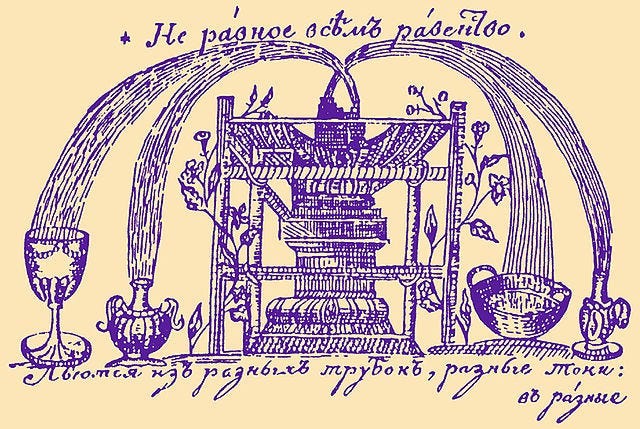
It has often been said by others that humans are fundamentally tribal beings and have a tendency to believe that they are right while some other group is wrong.
However, developing strategies to move forward, be it through political conflicts or business challenges, requires an understanding of all sides. When analysis begins with moral certainty instead of curiosity, understanding usually stops where the narrative begins.
This publication exists because I am interested in the questions (and answers, if possible) that appear once those preconceived narratives are set aside.
Author’s Perspective
I was born and raised in Ukraine where my ancestors lived in the same region for more than three centuries. During that time the land we lived on was ruled by the Polish–Lithuanian Commonwealth, the Cossack Hetmanate, the Russian Empire, the Soviet Union, and eventually independent Ukraine.
Growing up in a place where history layers itself like that makes it difficult to believe simple narratives about how the world works.
People, societies, and institutions operate under very different conditions. Ignoring their histories, incentives, and constraints invariably leads to shallow analysis and poor decisions.
The Fulcrum Point™ Dispatch is a place where I explore complex problems from angles most choose to avoid.
For Paid Subscribers
Exclusive access to all of my articles.
Access to a subscriber-only chat where we can debate in a more thoughtful environment than the usual chaos of social media comment sections.
